The Security Perimeter: Lessons from the Elián González Operation
A firsthand lesson in layered security
The Sentinel behind The Watchman Imperative spent years in U.S. Army Special Operations and later served as a Deputy U.S. Marshal. Much of that experience involved a principle that applies far beyond military operations or federal law enforcement: security begins with controlling access to what you are trying to protect.
Sometimes that boundary is a military perimeter. Sometimes it surrounds a fugitive arrest team, a protected person, an aircraft, or a crime scene. In ordinary life, it may be the boundary of your property, your home, a campsite, a vehicle, or even the personal space surrounding your family in a crowded public place. The scale and circumstances change, but the underlying principle remains remarkably consistent.
I saw a memorable example of that principle during one of the most widely covered news events of 2000.
Behind the Headlines: Elián González
In the early morning hours of April 22, 2000, nine other Deputy U.S. Marshals and I sped through the gates of Homestead Air Force Base, red and blue emergency lights flashing. An Air Force security officer stood ahead, rapidly circling his arm—like a third-base coach sending a runner home. He waved us through without stopping, and we continued toward the flight line.
We were there because of a six-year-old boy whose name nearly everyone in America knew: Elián González.
For months, Elián had been at the center of an international custody battle after surviving the boat journey from Cuba that killed his mother. His Miami relatives wanted him to remain in the United States, while his father wanted him returned to Cuba. My view was that extended relatives living in another country had neither moral nor legal standing over a surviving father. Earlier that morning, federal agents had entered the Miami home where Elián was staying and taken him into federal custody. The dramatic photograph of an armed federal agent confronting the man holding Elián would quickly become one of the defining images of the entire affair.
I wasn’t involved in that raid. My small part in the story began immediately afterward. At the time, I was a Deputy U.S. Marshal temporarily assigned to Miami as part of a special federal fugitive enforcement initiative. Deputy Marshals had been brought in from districts around the country, and we were working with the DEA apprehending federal fugitives. Ten of us were pulled from that assignment that morning and sent racing to Homestead.
Using out-of-town deputies provided a layer of operational security. The Elián case was surrounded by extraordinary media attention, and bringing in deputies from outside the area reduced the likelihood that details of the operation would find their way to the press.
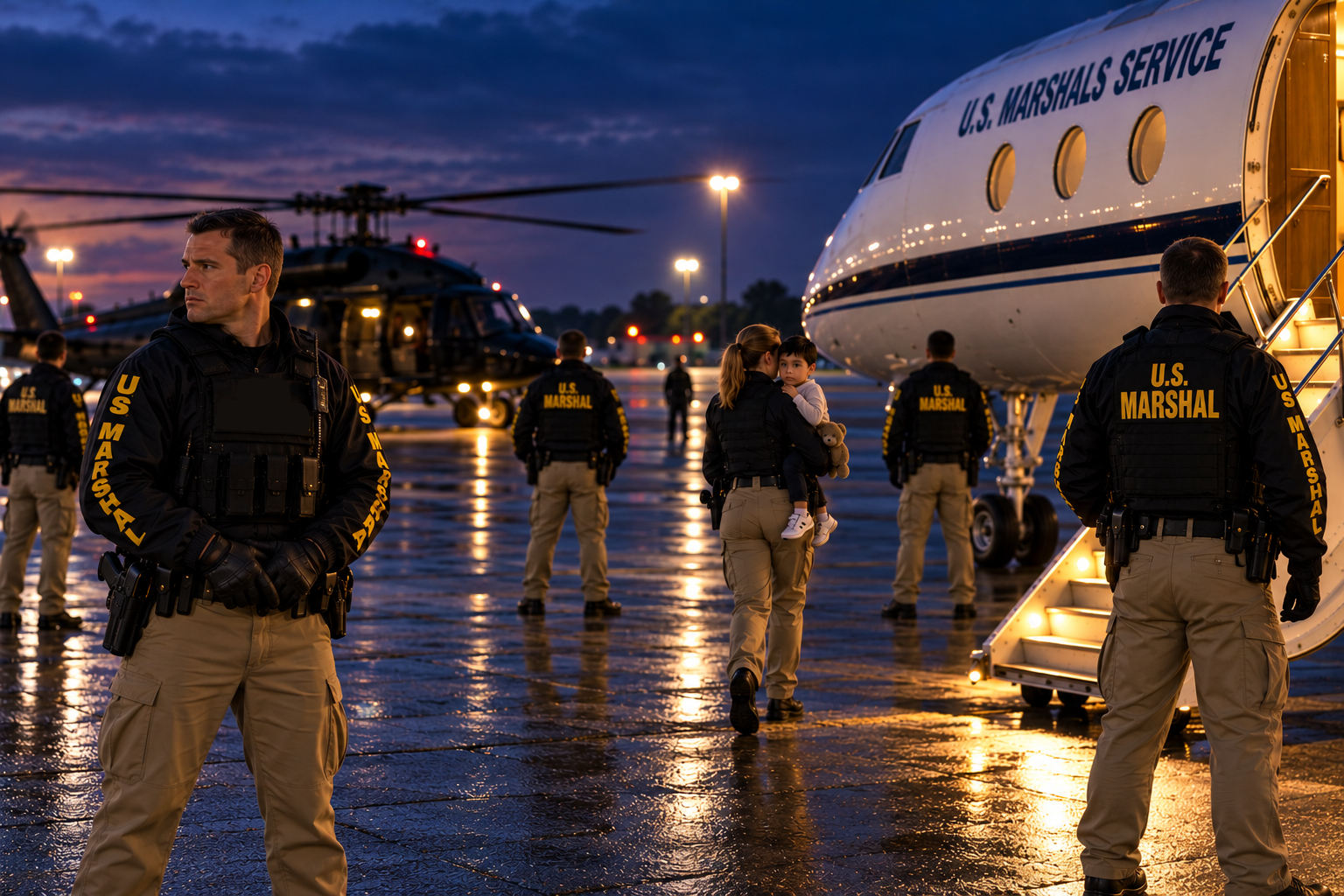
Once through the gate, we moved quickly to the flight line and established a circular security perimeter around a U.S. Marshals Service jet as it arrived. Ten Deputy Marshals stood spaced around the aircraft, wearing tactical vests and raid jackets that flapped in the early-morning Florida breeze. It was still dark, and within minutes the helicopter carrying Elián arrived.
A female federal INS agent carried Elián from the helicopter into a nearby structure for a brief medical examination. Moments later, they emerged and moved toward the waiting jet. We maintained the perimeter as Elián was placed aboard and the aircraft prepared to depart. Then the U.S. Marshals Service jet carrying Elián González rolled away and took off.
The radio was alive with coverage of the raid. By then, it was well understood that Elián was being taken toward Washington, but the operation had unfolded so rapidly that some of the reporting was still behind events. I recall hearing speculation that Elián had probably not even left Florida yet.
The ten of us knew otherwise.
While reporters were still trying to determine how far the operation had progressed, Elián González was already airborne and well on his way toward Washington.
We knew because we had just watched him leave.
The Lesson of the Perimeter
There was nothing particularly complicated about our immediate assignment at Homestead. Ten armed Deputy U.S. Marshals positioned themselves around an aircraft and controlled access to it. Yet that simple arrangement illustrates one of the most useful concepts in security: a perimeter creates space between something valuable and a potential threat.
The principle works because threats become more manageable when they must cross identifiable layers before reaching what you are protecting. A perimeter also gives the defender something equally valuable—time. Someone approaching an aircraft, a residence, a campsite, or a protected person is easier to recognize and respond to when you have established distance and boundaries around the protected area.
That concept does not require ten Deputy U.S. Marshals.
Around a home, the perimeter may begin at the property line with lighting, cameras, fencing, landscaping, gates, or simply an unobstructed field of view. The next layer might be the exterior of the house itself: doors, locks, windows, alarms, and additional cameras. Inside, another layer can protect sleeping areas, family members, important documents, communications equipment, or emergency supplies.
The same thinking applies when traveling or camping. Your perimeter may consist largely of awareness and distance. Where are the entrances and exits? Who is approaching? Are vehicles or people entering an area where they have no apparent reason to be? Is there enough distance to recognize a developing problem before it is immediately upon you?
Even personal security has a perimeter. Situational awareness effectively creates an invisible boundary around you. The person paying attention at fifty feet has considerably more options than the person who first recognizes a threat at five feet.
Layers, Not Fortresses
The objective is not to turn your home—or your life—into a fortress. It is to create layers that provide detection, delay, distance, and response time.
At Homestead that morning, the innermost asset happened to be a small aircraft carrying one of the most recognizable children in the world. The ten Deputy Marshals surrounding it were simply one layer within a much larger federal security operation.
The circumstances were extraordinary. The principle was not.
Whether protecting a federal aircraft, a family home, a campsite, or yourself in an unfamiliar environment, a well-considered perimeter serves the same fundamental purpose:
See the problem before the problem reaches you.
Watch. Prepare. Endure.