The Solar Still: An Emergency Method for Finding Water
By The Sentinel
Water is one of the most critical survival priorities, but finding a reliable source is not always easy. Rivers, streams, and lakes are not available everywhere, and even when they are, the water may require purification before it is safe to drink. This is why preparedness begins long before an emergency by storing an adequate supply of clean drinking water.
Even the best plans, however, can fail. Supplies can be exhausted, containers damaged, or an emergency may last far longer than anticipated. When that happens, knowing how to improvise becomes just as important as the equipment you own. One emergency technique that has been taught for decades is the solar still.
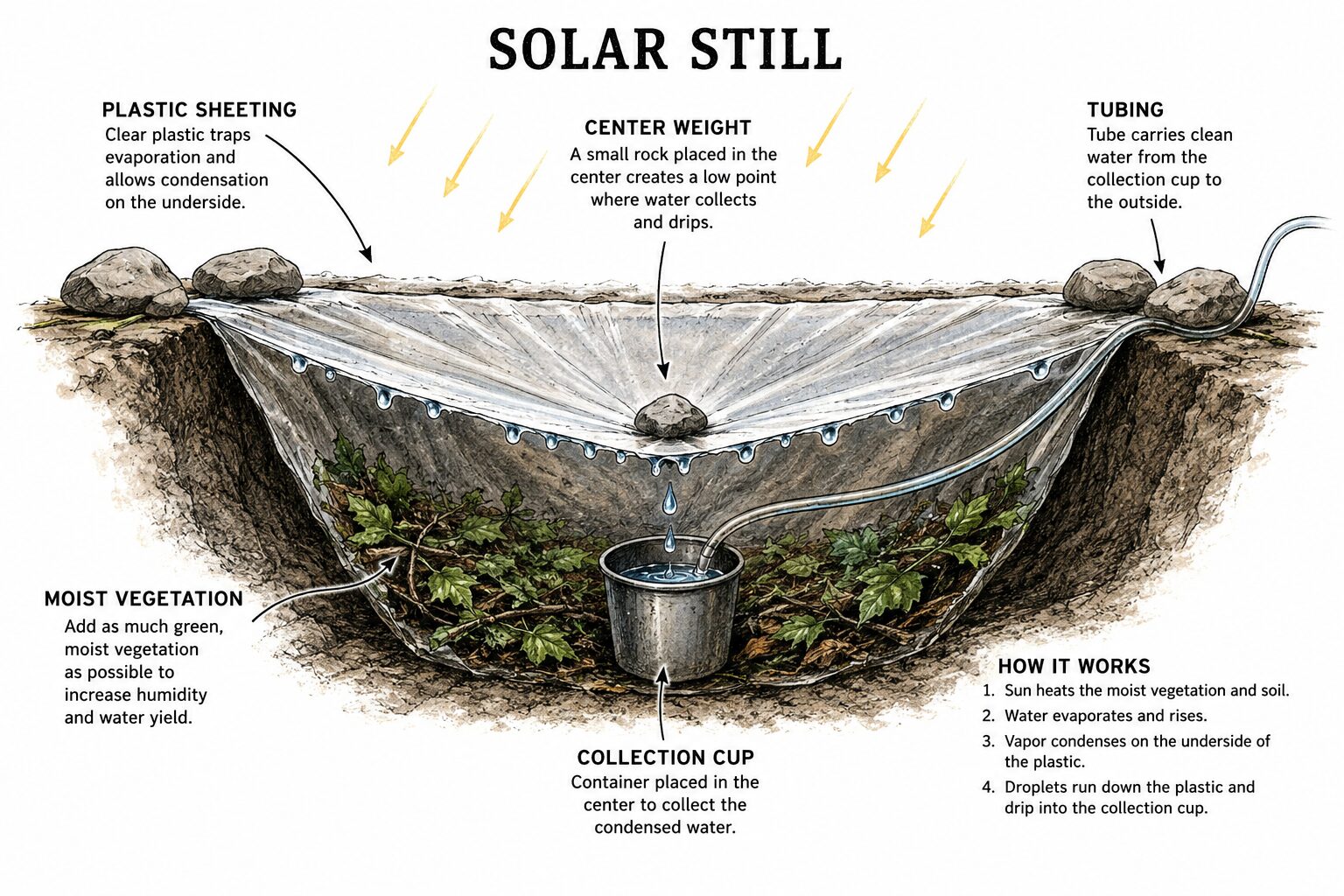
A solar still uses the sun’s heat to evaporate moisture from the ground or nearby vegetation. That moisture condenses on the underside of a sheet of clear plastic and eventually drips into a clean collection container. The process requires no electricity, no fuel, and only a few simple materials.
It is important to understand what a solar still can—and cannot—do. Many people assume it can produce enough water to meet all of their daily needs. In reality, production is usually quite limited. Depending on soil conditions, sunlight, temperature, and humidity, a solar still may produce only a cup or two of water over an entire day. It should be viewed as an emergency technique rather than a dependable source of drinking water.
Building a basic solar still is straightforward. Begin by selecting a location that receives direct sunlight for most of the day. Dig a bowl-shaped hole approximately two to three feet across and about two feet deep. Place a clean collection cup in the center of the hole. If available, add green vegetation around the cup or pour contaminated water into the surrounding soil, taking care that none of it splashes into the collection container.
Next, cover the hole with a sheet of clear plastic and seal the edges with soil or rocks to prevent moisture from escaping. Place a small stone in the center of the plastic directly above the collection cup, creating a downward slope. As the sun heats the soil and vegetation, moisture evaporates, condenses on the plastic, and runs toward the lowest point before dripping into the cup.
One advantage of this method is that many impurities remain behind during evaporation. The condensed water is generally free of salts and many contaminants because only the water vapor is collected. Even so, use common sense. If the plastic, collection container, or surrounding materials are contaminated, the collected water may not be safe. As with every survival skill, cleanliness matters.
The greatest lesson a solar still teaches is not how to collect water—it is how to think. Survival rarely depends on having the perfect piece of equipment at the perfect time. More often, it depends on recognizing the resources that are available and adapting them to solve the problem at hand. A sheet of plastic that normally serves as a drop cloth or ground cover can become a life-saving tool when used creatively.
Preparedness is built on layers rather than single solutions. Your first layer should always be storing enough clean drinking water for your family. Additional layers include rainwater collection, portable filters, boiling, chemical disinfection, and knowing how to improvise methods such as a solar still. None of these techniques is perfect by itself, but together they provide the flexibility needed to endure unexpected situations.
The goal of preparedness is not to master one survival trick. It is to develop the knowledge and mindset to overcome whatever challenges an emergency places in your path.
Continue Exploring
Preparedness is not a destination—it is an ongoing process of learning, planning, and serving others. Whether you are building practical skills, studying current events, or strengthening your family’s resilience, we invite you to continue exploring.
Learn more about the mission behind The Watchman Imperative on our About Page. If you have questions, suggestions, or would like to connect with us, visit our Contact Page.
Explore More:
Featured Content | Impactful Events | Resources | Newsletter