Emergency Cornering: Every Second Counts
Few people will ever find themselves fleeing a deadly threat in a vehicle. But if that day ever comes, your driving skills may become just as important as the vehicle itself.
Many people assume the key to escaping danger is simply driving faster. In reality, maintaining momentum through curves is often far more important than how fast you were traveling before you reached them. Every unnecessary tap of the brakes costs valuable time—and in a life-threatening situation, time is exactly what you cannot afford to waste.
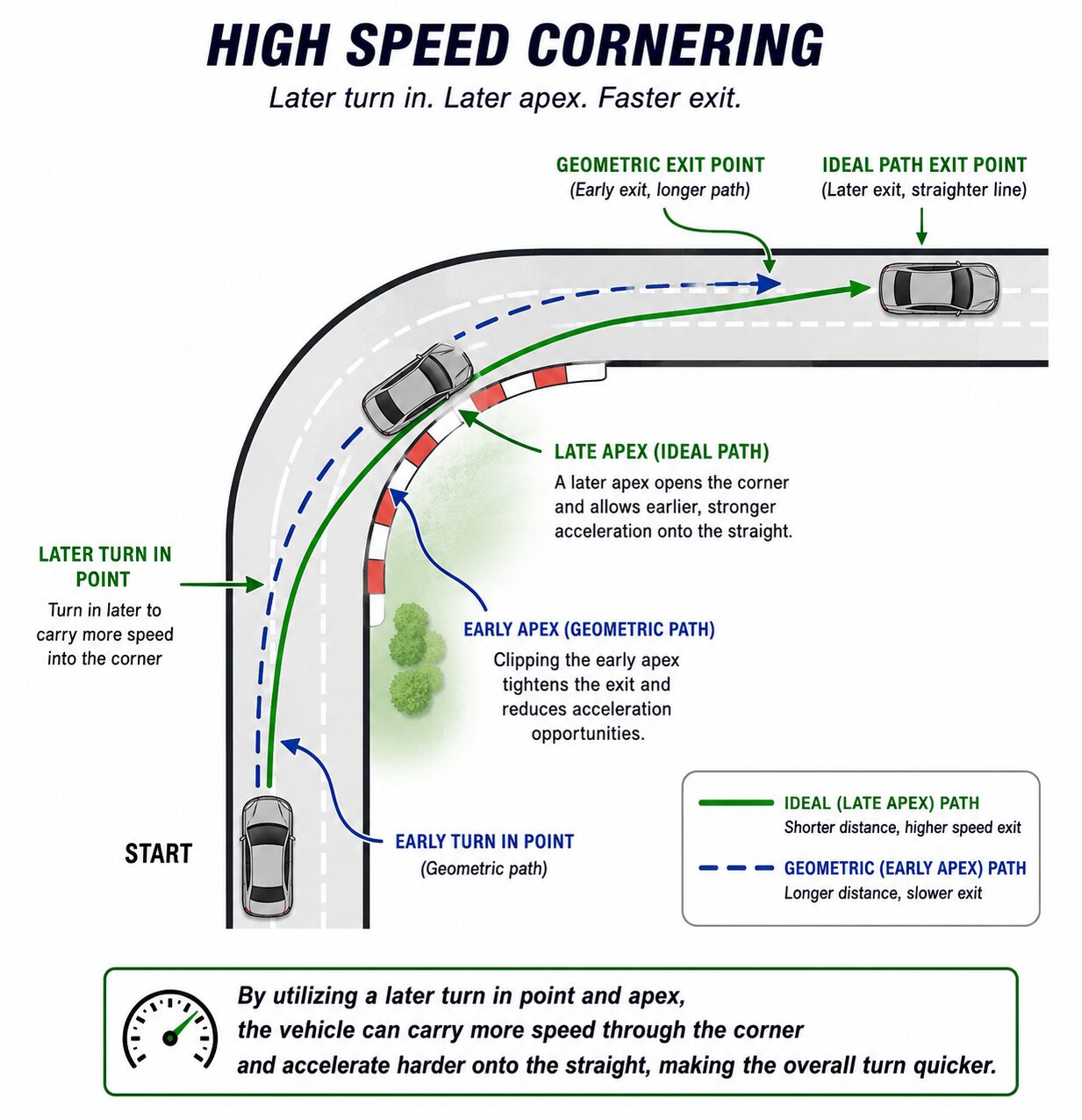
One of the most common mistakes drivers make is turning into a corner too early. This creates a tighter arc, requiring more steering input, more braking, and delaying acceleration as the vehicle exits the turn.
A better approach is to use as much of the available roadway as conditions safely allow. Although this results in a slightly longer path through the curve, the larger turning radius allows the vehicle to maintain greater speed while reducing the likelihood of exceeding the available traction and losing control.
During my training as a Deputy U.S. Marshal at the Federal Law Enforcement Training Center (FLETC), we were taught to use what is known as the late apex whenever conditions permitted. Rather than steering toward the inside of the turn immediately, the driver delays the turn slightly so the vehicle reaches the inside of the curve later. This allows the steering wheel to be straightened sooner, making it possible to accelerate earlier onto the following straightaway. Although the distance traveled may be slightly longer, the higher exit speed often reduces the total time required to negotiate the turn.
The purpose of the late apex is not simply to enter the turn faster—it is to exit the turn faster while maintaining control. Entering a corner too quickly often forces the driver to brake during the turn, while a properly executed late apex positions the vehicle for stronger, smoother acceleration as the road straightens.
Real-World Considerations
Emergency driving is very different from driving on a closed course.
Many curves on public roads are blind, meaning you cannot see whether another vehicle is approaching. Crossing completely into the opposing lane on a blind curve is usually an unnecessary gamble. Instead, maximize the width of your own lane as you enter the turn. As visibility improves and you have positively confirmed there is no oncoming traffic, you may then be able to safely utilize more of the roadway while accelerating out of the curve.
Be especially mindful of the roadway shoulder. Loose gravel, dirt, leaves, and other debris provide significantly less traction than pavement. Drifting onto the shoulder can quickly reduce your ability to recover, while leaving the roadway altogether greatly increases the risk of a rollover or collision with trees, utility poles, culverts, embankments, or other fixed objects.
Modern GPS navigation systems can also become valuable emergency tools. The moving map often reveals approaching curves before they come into view, allowing you to anticipate their direction and severity. It can also alert you to approaching intersections, stop signs, traffic signals, and other hazards that may require slowing down.
Prepare Before the Emergency
Preparedness begins long before you ever need to escape.
Your tires are the only part of the vehicle that actually contacts the road, making them one of its most important safety components. Purchase quality tires from a reputable manufacturer, maintain proper tire pressure, and replace them before age or wear significantly reduces their performance. If appropriate for your vehicle, consider tires with stronger construction or reinforced sidewalls that may better withstand impacts from potholes, curbs, and road debris.
One lesson repeatedly learned during law enforcement vehicle pursuits is that the lead vehicle is often at the disadvantage. The fleeing driver encounters every pothole, sharp curve, disabled vehicle, curb, and unexpected obstacle first. The pursuing officers, on the other hand, can often observe those hazards and adjust their own driving before reaching them.
Many pursuits have ended not because the fleeing vehicle lacked horsepower, but because it struck an obstacle, suffered one or more flat tires, and was forced to continue on the rims. It is not uncommon for a fleeing vehicle to continue for some distance on two—or even three—destroyed tires before finally becoming disabled. A stronger tire cannot guarantee survival, but quality equipment and proper maintenance may provide the margin needed to keep moving.
Finally, remember that no driving technique can overcome the laws of physics. Rain, snow, ice, worn tires, excessive speed, and poor judgment all reduce your margin for error. The techniques discussed here are intended for situations involving an immediate threat to life—not everyday driving. The objective is not reckless speed. The objective is maintaining control, making sound decisions, and reaching safety.
Preparedness Takeaway
Preparation doesn’t begin when danger appears—it begins long before.
Learning proper emergency driving techniques, maintaining your vehicle, and investing in quality equipment can significantly improve your chances should the unthinkable occur. In a crisis, success is rarely the result of luck. More often, it is the product of preparation, discipline, and sound decision-making.